AI Governance

10 Best AI Governance Platforms in 2026 for Enterprise IT

Share via:
Written by:
CloudEagle.ai Team
Reviewed by
Nidhi Jain
Last Updated:
January 2, 2026
blog-cms-banner-bg
Little-Known Negotiation Hacks to Get the Best Deal on Slack
cta-bg-blogDownload Your Copy

HIPAA Compliance Checklist for 2025

Download PDF

‍

Only 13% of organizations believe they have the right governance in place for AI agents, according to Gartner. Gartner also expects the average Fortune 500 enterprise to run more than 150,000 agents by 2028, up from fewer than 15 in 2025.

Inside most companies, that gap already looks familiar. Your security team blocks one AI tool, and by Friday three more show up in expense reports. An agent built by a contractor who left last month still has write access to your CRM.

An AI governance platform closes it, and the payoff is measurable. In a Gartner survey of 360 organizations, those that deployed AI governance platforms were 3.4 times more likely to achieve high effectiveness in AI governance.

‍

An AI governance platform is software that discovers the AI tools, models, and agents an organization uses, assesses their risk against policy and regulations such as the EU AI Act, enforces controls on access and data, and records audit-ready evidence.
👉 The leading platforms in 2026 include CloudEagle.ai, IBM watsonx.governance, ServiceNow AI Control Tower, Credo AI, and OneTrust.

‍

Below, we compare the 10 best AI governance platforms for enterprise IT and Security teams and show how to pick the right one for what you need to govern.

‍

What an AI Governance Platform Does: 4 Core Capabilities

Every AI governance platform does some version of four jobs.

Gartner describes the category as a central registry of AI systems that automates approvals for new AI use cases and agents and runs guardrails in real time (Gartner Peer Insights).

1. AI discovery and inventory: The platform finds every AI tool, model, copilot and agent in use, including shadow AI that employees adopted without IT.

Ask vendors which signals they read: SSO, browser, finance records, cloud platforms, or all of them.

2. Risk and compliance mapping: Each AI system gets a risk classification mapped to frameworks such as the EU AI Act, NIST AI RMF, and ISO 42001.

The better platforms generate evidence as a byproduct of normal work.

3. Policy enforcement and guardrails: Written policy turns into controls: who can use which AI tools, what data can be shared with them, and what actions an agent may take.

Some platforms only report violations; others block, redirect, or require approval at the moment of use.

4. Observability and audit trails: The platform tracks usage, token consumption, agent actions, and model behavior over time, and logs every decision and exception for auditors.

Some AI governance platforms govern how employees and agents use AI across the business: shadow AI, embedded SaaS AI, AI spend, and the machine identities agents run under. 

‍

Others govern the models your data science teams build: lifecycle documentation, bias testing, and drift monitoring. Buying the wrong half is the costliest mistake in this market, so the table below shows what each platform governs. 

‍

Where Does Your AI Governance Rank?

69% have no accountable AI owner. Benchmark yours before you pick a platform
Grab your copy

‍

How We Evaluated These AI Governance Platforms

We assessed each platform against six criteria using vendor documentation, 2026 announcements, analyst research, and peer reviews. 

Criterion What we looked at
Coverage Whether it governs employee AI usage, embedded SaaS AI, models, agents, or a combination
Discovery depth How many signals feed the AI inventory and whether shadow AI is found automatically
Enforcement Whether the platform only reports, or also blocks, redirects and routes approvals
Agent and NHI governance Owners, permissions, lifecycle and shutdown controls for AI agents and machine identities
Compliance evidence Mapping to the EU AI Act, NIST AI RMF and ISO 42001, plus audit-ready logs
Validation and time to value Analyst recognition, peer reviews and how quickly teams get usable visibility

‍

10 Best AI Governance Platforms in 2026 - For IT & Security Teams

The table below maps all ten platforms across capability dimensions critical to enterprise AI governance decisions.

Platform Best for What it governs Gartner MQ 2026 Shadow AI discovery Agent and NHI governance
CloudEagle.ai IT, Security and Procurement teams Employee AI usage, AI spend, agents, NHIs, SaaS Not in MQ (KuppingerCole 2026 Leadership Compass) Automated, multi-signal Owners, expiry, access reviews, kill switch
IBM watsonx.governance Regulated enterprises with model risk programs Models, agents, AI use cases Leader Via Guardium AI Security Lifecycle monitoring; containment in preview
ServiceNow AI Control Tower Organizations already on ServiceNow AI assets, models, agents Leader Via Service Graph connectors Lifecycle workflows, kill switch protocol
Credo AI Policy-led risk and compliance teams AI use cases, models, agents Visionary Intake and registry based Agent registry; Agent Governor in preview
OneTrust AI Governance Privacy and legal-led programs Models, agents, datasets, vendors Visionary Cloud AI discovery Agent registration, MCP policy controls
Holistic AI Multi-jurisdiction compliance Models, agents, applications Challenger Automated Guardian Agents
Airia Teams building and orchestrating agents Agents, models, MCP tools Visionary Automated Runtime agent constraints
Singulr AI Security teams securing GenAI use SaaS AI, embedded AI, agents Not in MQ Automated Agent Pulse
Securiti AI (Veeam) Data and privacy-first programs Data feeding AI systems Not in MQ Partial Partial
Microsoft Agent 365 Microsoft-standardized enterprises Microsoft and synced agents Not in MQ Shadow AI page in admin center Agent registry and lifecycle actions

‍

1. CloudEagle.ai

Best for: IT Teams, CIOs, CISOs, and Chief AI Officers who need to govern employee AI usage, AI spend, and AI agents alongside the rest of the SaaS stack.

‍

‍

CloudEagle.ai is an AI Governance, SaaS Security, and SaaS management platform that gives enterprises one command center to discover, secure, govern, and optimize their SaaS and AI stack, including AI usage control and both human and non-human identities. 

KuppingerCole Analysts named it a Product Leader in the 2026 Leadership Compass for SaaS Security and AI Governance, and Gartner named it a Representative Vendor in the 2026 Market Guide for Identity Governance and Administration.

It starts from what IT and Security teams actually face: AI tools employees adopt on their own, AI spend spread across vendor consoles, and agents running under machine identities nobody owns.

‍

Customers have saved $3B+ across SaaS and AI spend, with 30-minute onboarding and 500+ direct integrations.

‍

a. Find every AI tool employees use, approved or not

AI tools enter the stack through free trials, card purchases, and personal accounts that never touch SSO. 

CloudEagle.ai's shadow AI discovery builds a live inventory from EagleIQ, its proprietary AI application inventory, and correlates browser, SSO, finance, Zscaler, and CrowdStrike signals to surface sanctioned and unsanctioned tools in one dashboard. That is how teams catch AI tools running silently before they become embedded in daily work.

Once every tool is visible, the next question is what each one costs and who is using it.

b. See what every AI tool consumes and costs, down to the user and API key

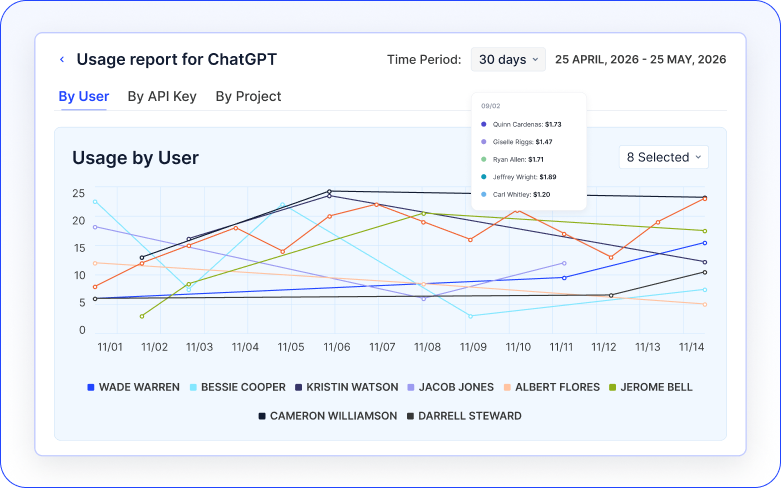
AI tools bill in licenses, tokens, and credits, each inside its own vendor console. AI usage control brings that consumption into one view, tracks fixed licenses and pay-as-you-go tokens side by side, and maps cost to users, teams, cost centers, API keys, and non-human identities. 
‍

ChatGPT usage report showing a user-wise line chart tracking API usage across eight users over a 30-day period.

‍

Finance teams get AI spend they can track by model, user, and department with per-user or team budgets and alerts, and IT reclaims licenses inactive for 90 or 180 days through Slack or Teams approval workflows.

Domo ran Claude, Cursor, and Gemini across engineering, product, and go-to-market teams, with $2.4M in annual AI spend split across separate vendor consoles. 

Once CloudEagle.ai pulled that consumption into one view, Domo found 34% of its AI licenses had no activity in 90 days. Removing inactive access and consolidating overlapping subscriptions saved $1.2M in the first quarter, and AI spend reconciliation moved from quarterly to weekly.

With usage mapped, the next step is enforcing policy where AI is actually used.

c. Stop sensitive data from reaching unapproved AI, right in the browser

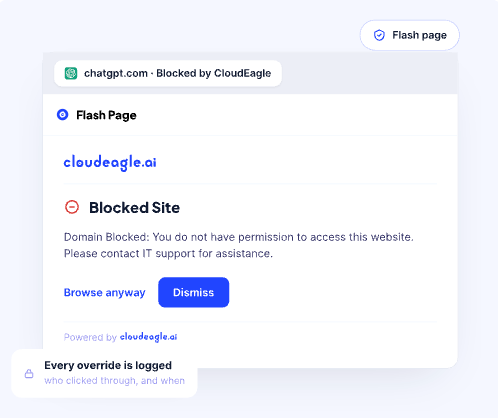
Most AI use happens in a browser tab. CloudEagle.ai's browser plugin brings AI policy enforcement to that layer. When someone opens an unapproved AI tool, a flash page redirects them to an approved one. 
‍

CloudEagle.ai Flash Page displaying a blocked ChatGPT website with options to browse anyway or dismiss the access request.

‍

Policies set by user, role, department, and data type monitor or block PII, credentials, financial data, and PHI before they are entered, and every warning, block, and override is logged for audit.

The last gap is the AI that acts on its own.

d. Give every AI agent and API key an owner, an expiry date, and a kill switch

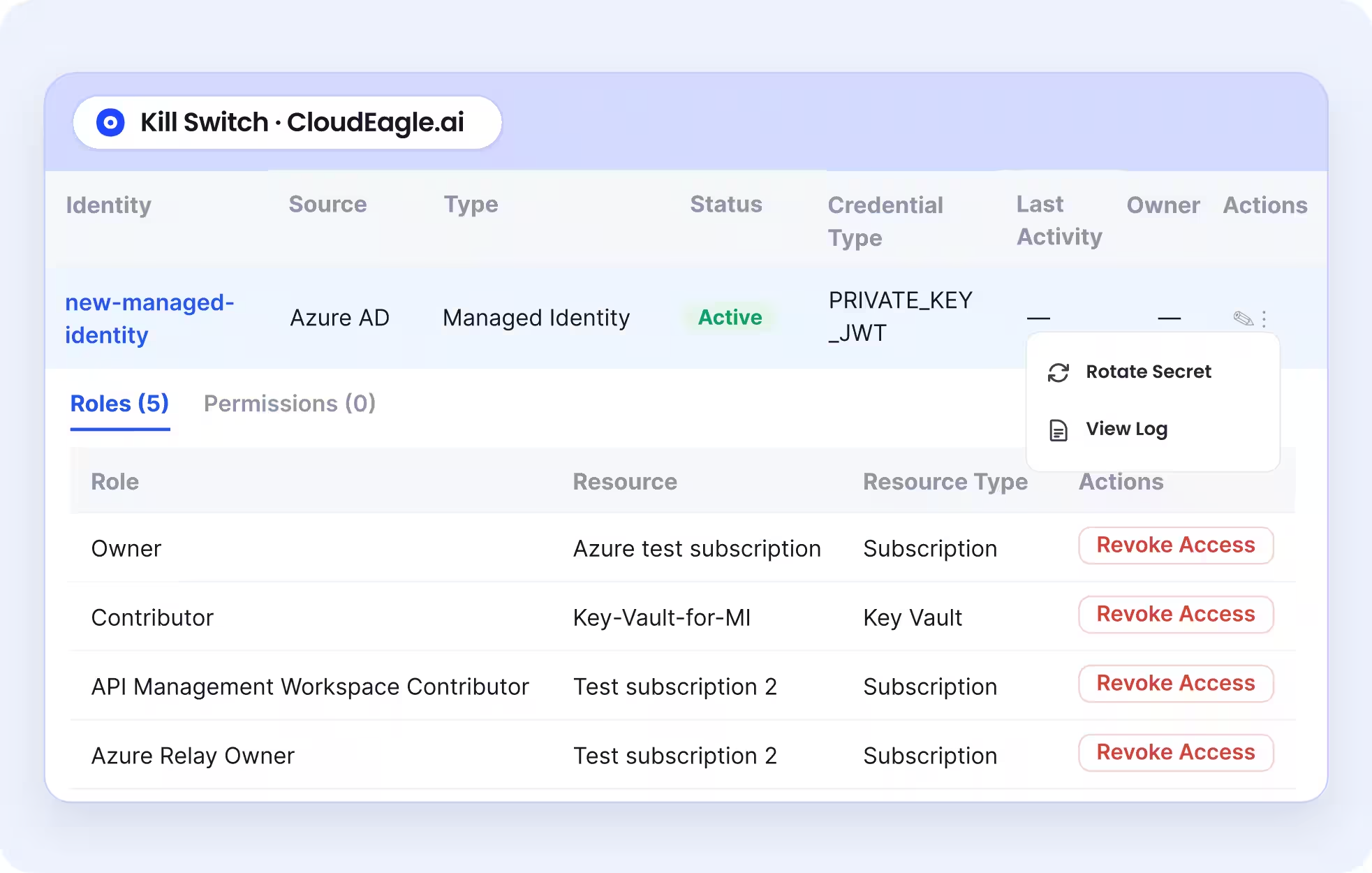
Service accounts, API keys, and AI agents are often created with no owner and no expiry. Non-human identity management discovers AI agents, MCP servers, service accounts, and API keys, assigns an owner and expiry to each, and pulls them into access reviews and least-privilege checks. 
‍

CloudEagle.ai Kill Switch dashboard showing Azure managed identity details, assigned roles, credential type, activity logs, and options to rotate secrets or revoke access.

‍

AI agent management shows what each agent can reach, flags agents whose owner has left, and gives admins a kill switch for any agent that should not be running.

‍

"Once AI adoption accelerated across teams, visibility alone wasn't enough. We needed clear rules around who could use AI tools, under what conditions, and how those decisions were enforced and reviewed. CloudEagle helped us move from ad-hoc approvals to structured, defensible AI governance." Aditya Khosla, CTO, Iterative Health 

‍

Where it falls short: CloudEagle.ai governs how AI is used across the business. Teams that need model-level bias testing or drift monitoring for models they build in-house will pair it with a model governance tool.

CloudEagle.ai Pricing: Modular, with custom quotes based on the modules you need. Contact sales.

‍

‍

2. IBM watsonx.governance

Best for: Banks, insurers and other regulated enterprises with formal model risk programs.
‍

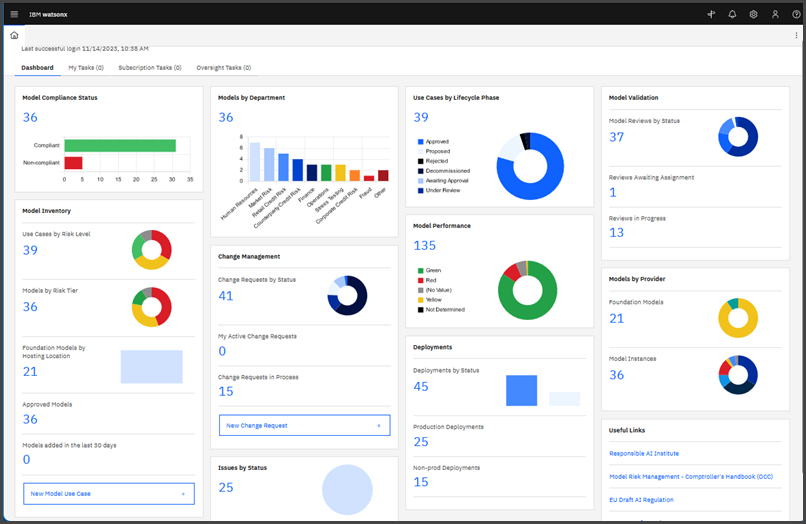
IBM watsonx dashboard displaying AI model compliance status, model inventory, departmental distribution, lifecycle stages, validation metrics, and deployment statistics.

‍

IBM watsonx.governance manages risk and compliance across the lifecycle of models, applications and agents, and Gartner placed IBM highest among the 2026 Leaders. In October 2026, IBM added agent discovery and containment, including a kill switch, across Amazon Bedrock, Microsoft Foundry and Google Gemini as a tech preview.

Key capabilities:

  • Lifecycle governance from use-case intake to retirement
  • Risk Atlas covering agentic AI risks, plus bias and drift monitoring
  • Use-case discovery through Guardium AI Security

Where it falls short: Heavy to deploy outside the IBM ecosystem, and focused on systems teams build rather than the AI tools employees adopt on their own.

IBM watsonx.governance Pricing: An Essentials SaaS tier is billed per resource unit; enterprise pricing is quoted. Teams comparing options can review our IBM watsonx.governance alternatives.

‍

3. ServiceNow AI Control Tower

Best for: Enterprises that already run risk, change and service management on ServiceNow.
‍

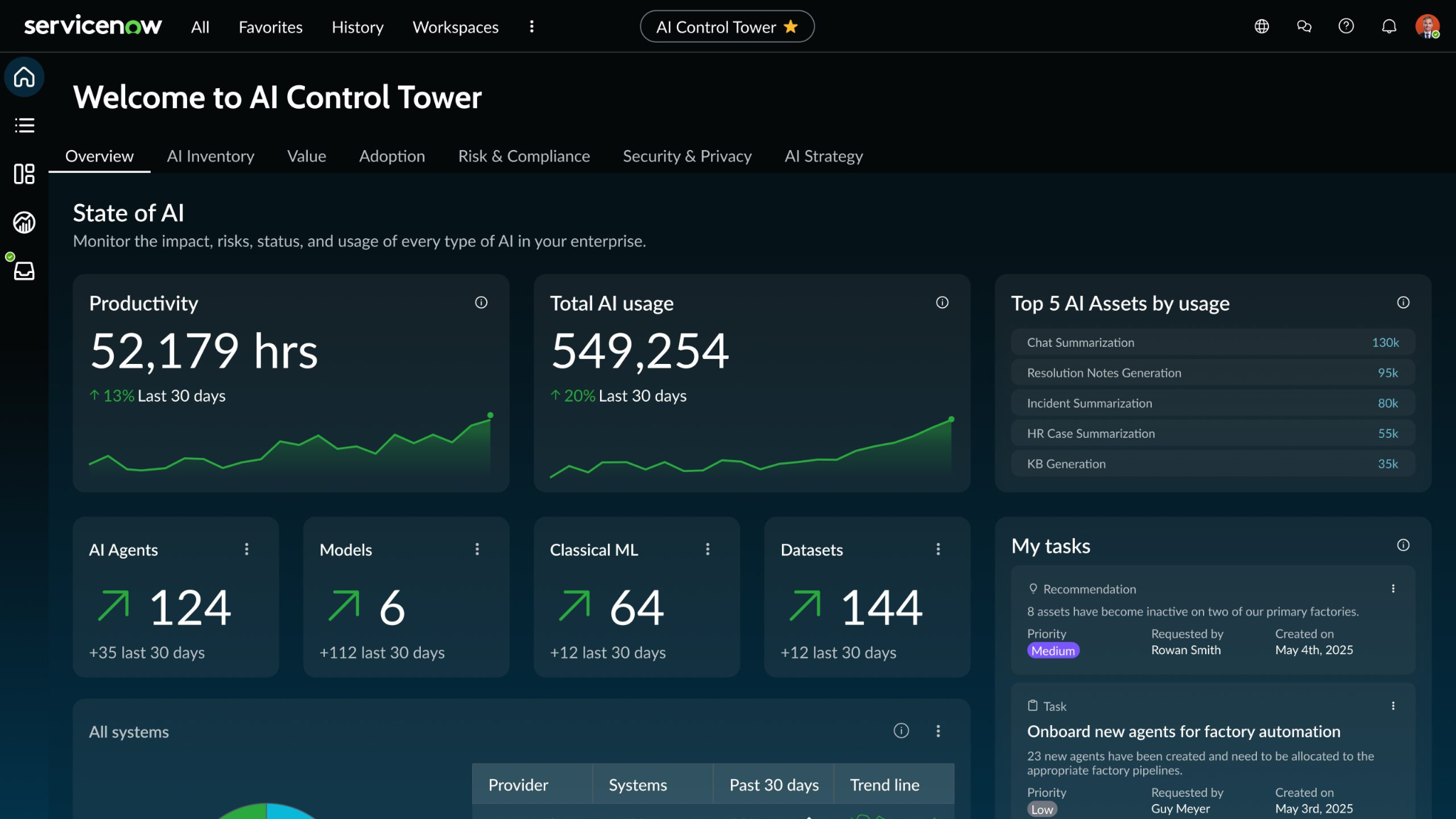
ServiceNow AI Control Tower dashboard displaying enterprise AI productivity, usage trends, AI agents, models, datasets, and task execution metrics.

‍

ServiceNow AI Control Tower is a governance layer above native and third-party AI, and a 2026 Gartner Leader. The June 2026 release added discovery connectors for Databricks, Snowflake and Hugging Face, publishing to Microsoft Agent 365, and pre-built compliance content.

Key capabilities:

  • Vendor-agnostic inventory of AI agents, models and workflows
  • Approval workflows tied to each asset's lifecycle phase
  • Kill switch protocol to deactivate and reinstate agents

Where it falls short: Value depends on being a ServiceNow shop, and configuration takes real effort for teams early in their governance program.

ServiceNow Pricing: Not published; sold within ServiceNow enterprise agreements.

‍

4. Credo AI

Best for: Risk and compliance teams that need regulatory mapping across a multi-cloud AI portfolio.
‍

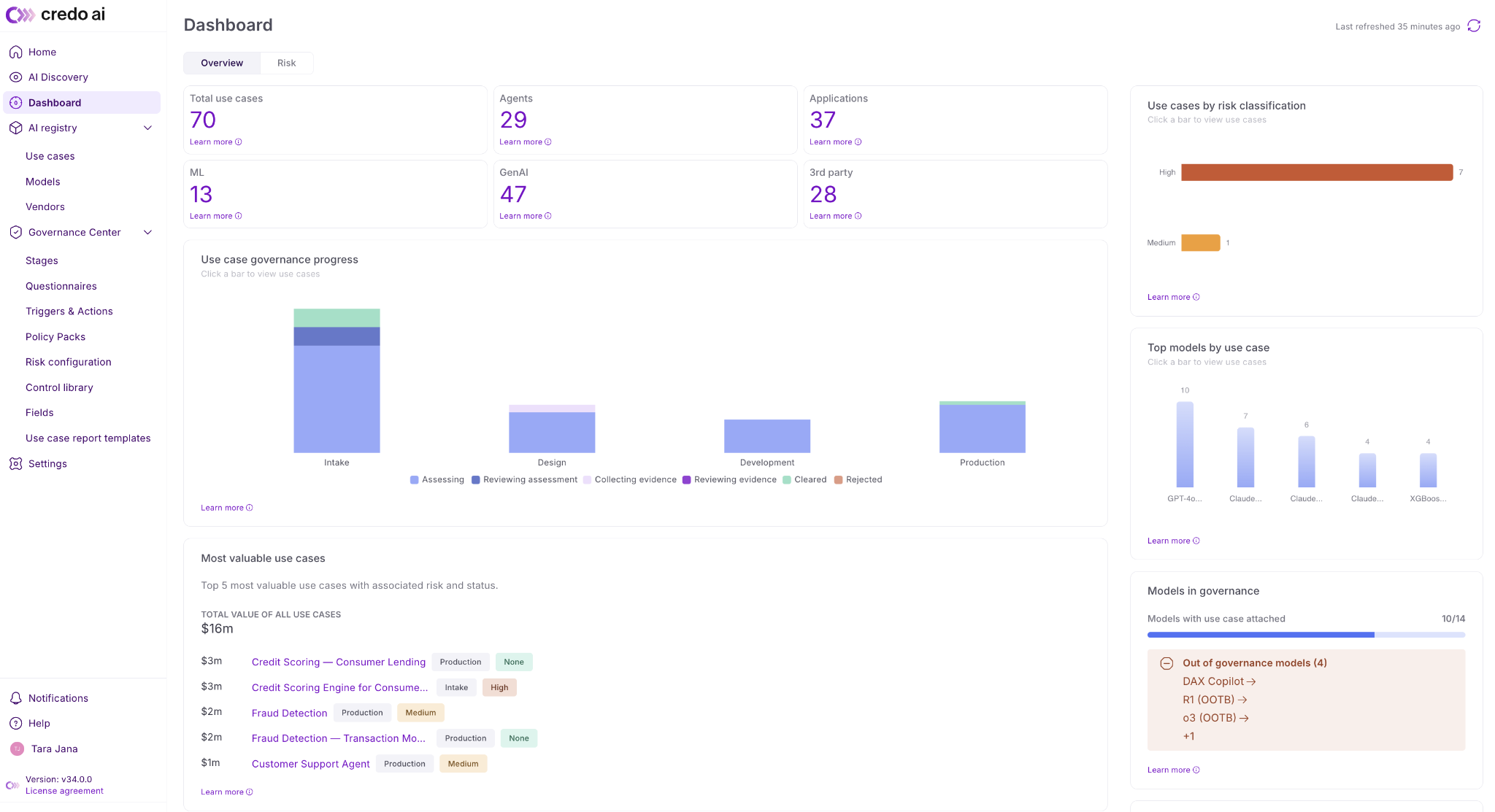
Credo AI governance dashboard showing AI use cases, agents, applications, risk classifications, governance progress, model inventory, and compliance status.

‍

Credo AI is a policy-first platform that turns regulation and internal policy into requirements teams can act on, and a Gartner Visionary. Its governance agent, GAIA, became generally available in May 2026 to automate intake and assessments, and Agent Governor followed in July 2026.

Key capabilities:

  • Policy packs aligned to the EU AI Act, NIST AI RMF and ISO 42001
  • Central registry of AI use cases, models and agents
  • Audit-ready reporting for regulators and boards

Where it falls short: Stronger on assessment and documentation than on runtime enforcement, and it assumes a written AI policy already exists.

Credo AI Pricing: Custom. See how it compares in our Credo AI alternatives guide.

‍

5. OneTrust AI Governance

Best for: Privacy, legal and compliance-led organizations already using OneTrust.
‍

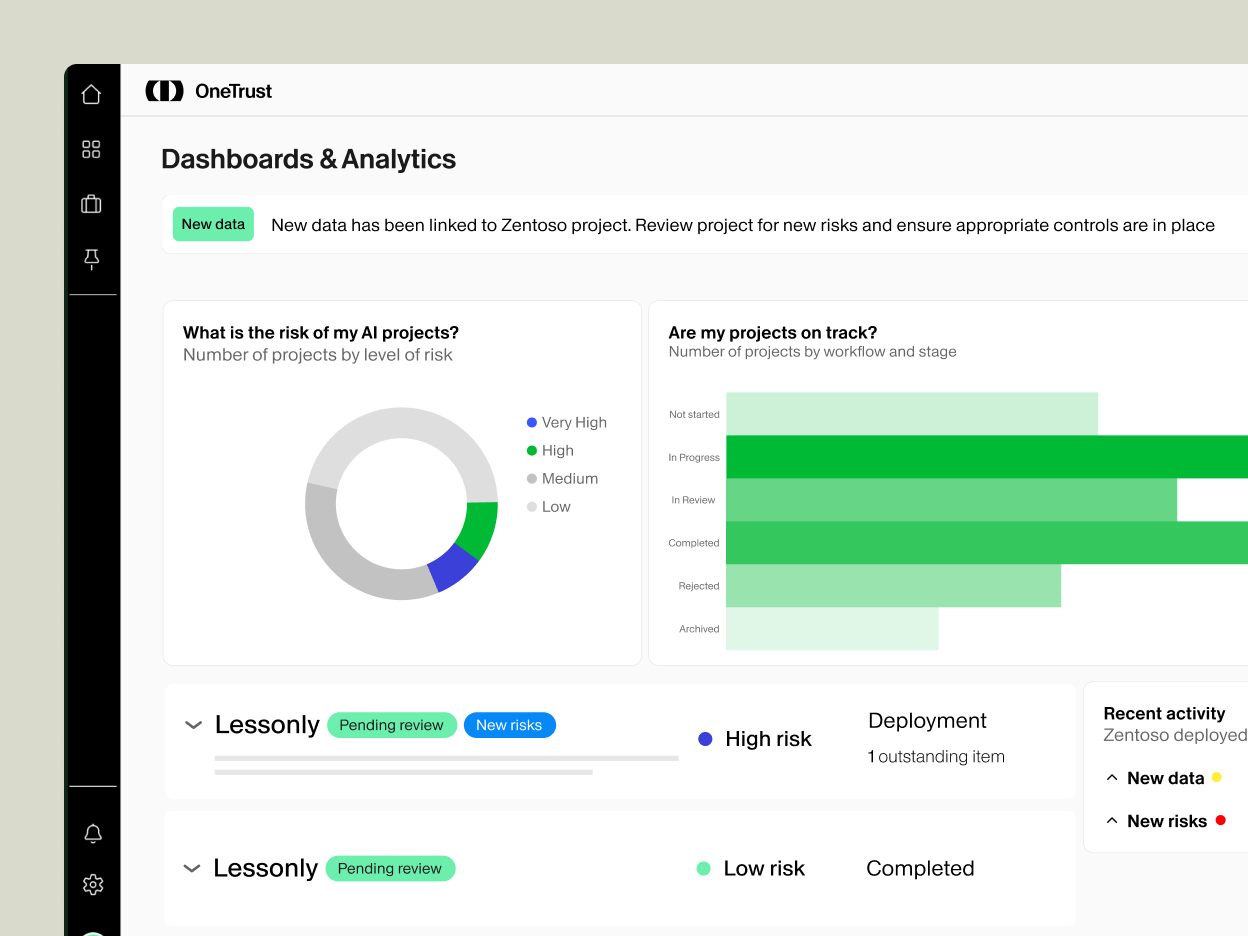
OneTrust dashboard displaying AI project risk distribution, workflow progress, project status, and recent governance activity.

‍

OneTrust extends its privacy and GRC platform to AI, and is a Gartner Visionary. In 2026, it added agent detection across Bedrock, Azure Foundry, Vertex and Databricks, then launched CORIE in September to enforce policy on agent actions at runtime.

Key capabilities:

  • AI inventory spanning models, agents, datasets and vendors
  • Agent registration with enforced permissions and MCP policy controls
  • Runtime guardrails that block, redact or restrict AI behavior

Where it falls short: The AI modules are newer than the privacy core, and full value usually means adopting more of the OneTrust platform.

OneTrust Pricing: Custom enterprise pricing. To know how CloudEagle.ai compares with OneTrust, check out our guide on OneTrust Alternatives. 

‍

6. Holistic AI

Best for: Organizations tracking AI regulation across several jurisdictions.
‍

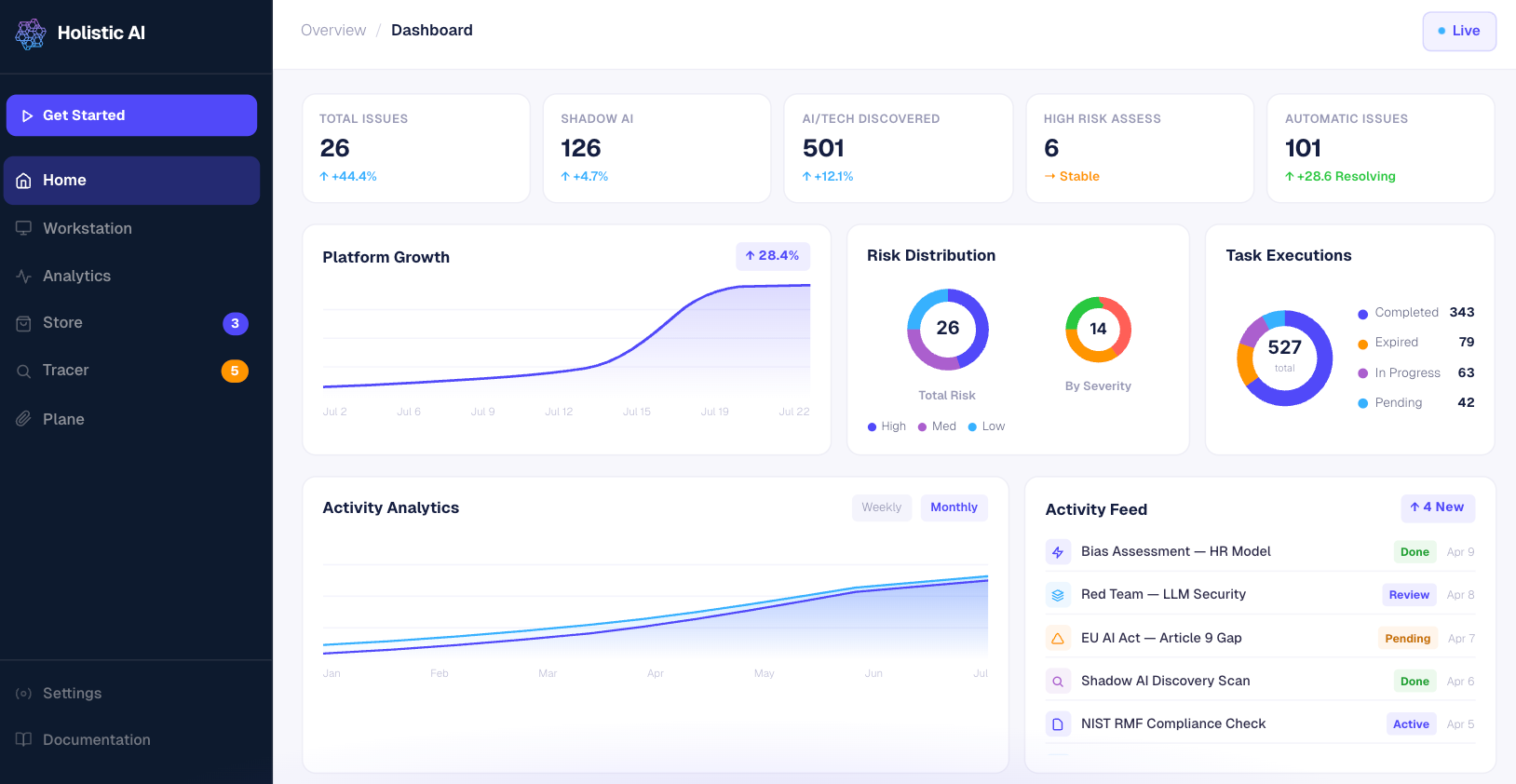
Holistic AI dashboard showing shadow AI discovery, technology inventory, risk distribution, platform growth, task executions, and security activity analytics.

‍

Holistic AI covers discovery, risk assessment and enforcement in production, and was Gartner's sole 2026 Challenger. Holistic AI says it scored highest for AI Discovery and Registry in Gartner's Critical Capabilities research.

Key capabilities:

  • Live inventory of models, agents, apps and third-party AI, including shadow AI
  • Guardian Agents that monitor and intervene when a policy threshold is breached
  • Evidence mapped to the EU AI Act, NIST AI RMF and ISO 42001

Where it falls short: Peer-review volume is still thin, and it does not cover AI spend or SaaS access governance.

Holistic AI Pricing: Custom.

‍

7. Airia

Best for: Teams building and running many internal agents that want governance where the agents execute.
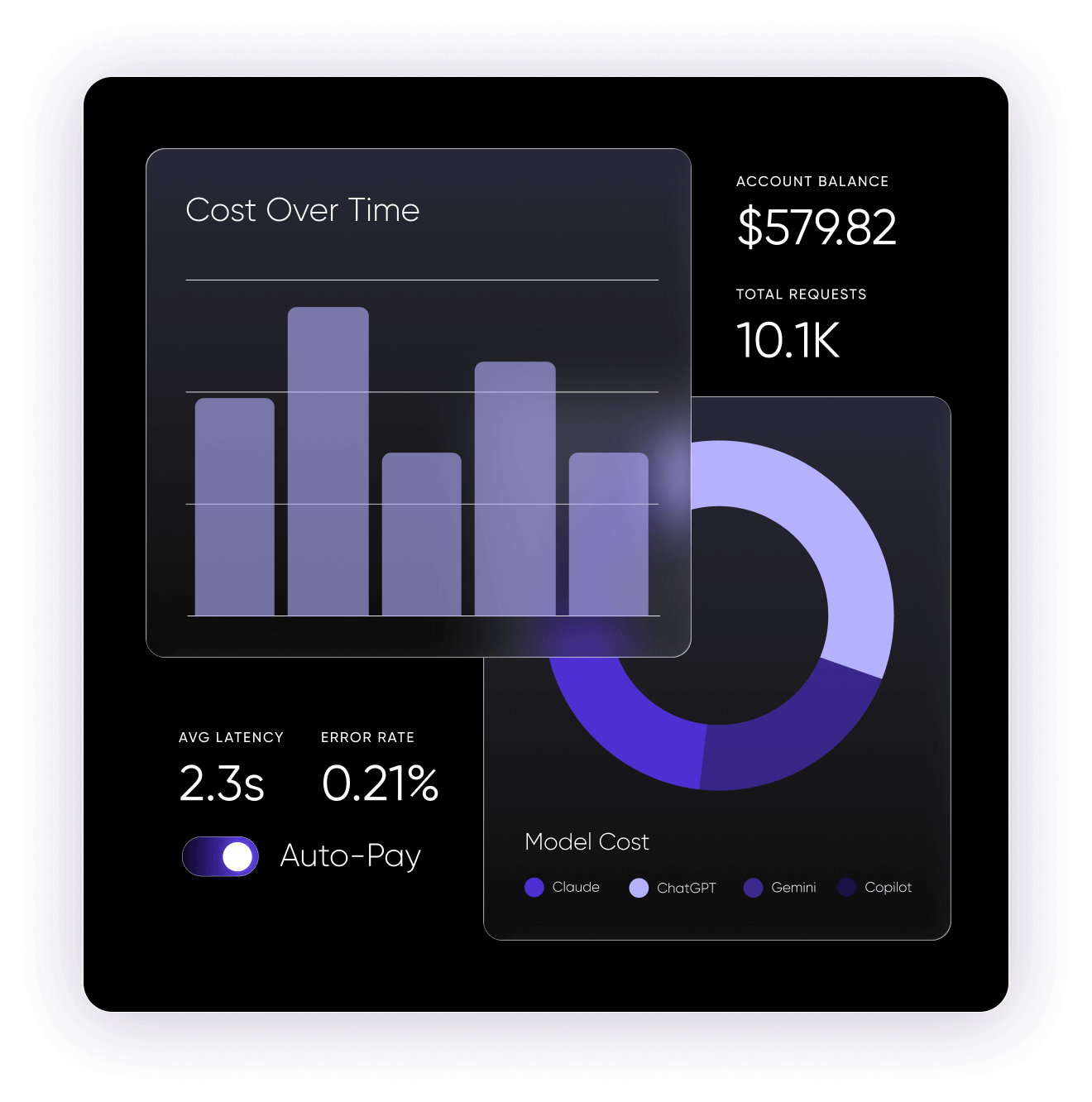
Dark-themed AI analytics dashboard displaying model costs over time, account balance, total requests, average latency, error rate, and cost distribution across Claude, ChatGPT, Gemini, and Copilot.

‍

Airia combines AI orchestration, security and governance in one control layer. It launched its AI Governance product in January 2026 and is a Gartner Visionary.

Key capabilities:

  • Discovery of AI tools, agents and MCP servers across identity, network, SaaS and browser signals
  • Agent constraints enforced at the function-call level, including for agents built elsewhere
  • Execution-level logging for audit

Where it falls short: Strongest when you also orchestrate agents in Airia, and as a younger vendor, reference checks take longer.

Airia Pricing: Not published. Compare options in our Airia alternatives guide.

‍

8. Singulr AI

Best for: Security teams focused on securing employee GenAI use and agent activity.
‍

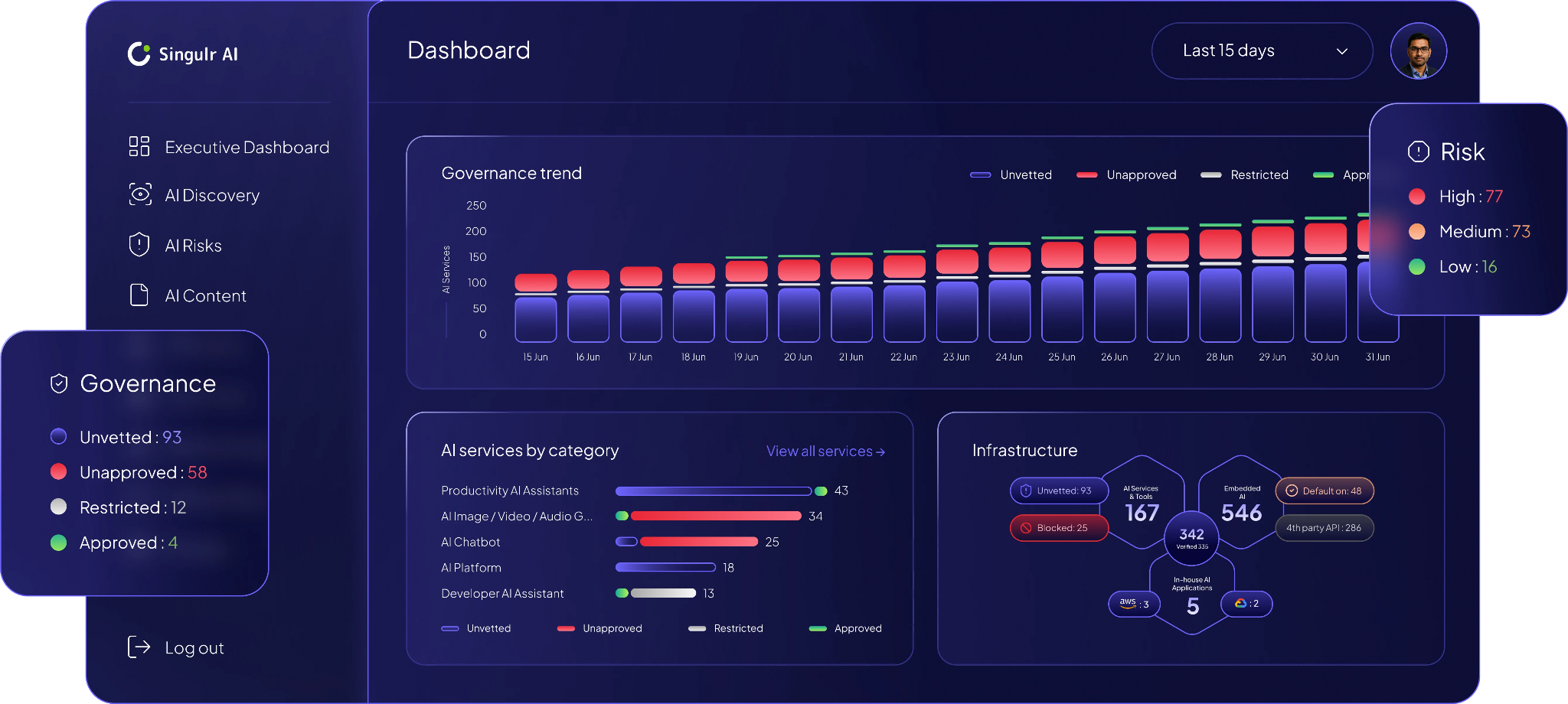
Singulr AI dashboard displaying AI governance trends, unvetted and unapproved AI services, risk classifications, AI service categories, and infrastructure insights.

‍

Singulr AI positions itself as an AI and agentic control plane. Its Agent Pulse product discovers agents across Copilot Studio, Agentforce, AWS, Google Cloud, and local machines, and in July 2026 coverage extended to endpoints, AI gateways, and MCP.

Key capabilities:

  • Discovery of public AI services, embedded SaaS AI, and agents
  • Singulr Pulse risk intelligence and AI red teaming
  • Runtime protection against prompt injection and data leakage

Where it falls short: Not evaluated in the Gartner Magic Quadrant, and it does not cover AI license spend or identity lifecycle across SaaS. See our Singulr alternatives.

Singulr AI Pricing: Contract-based; also available through AWS Marketplace.

‍

9. Securiti AI (now part of Veeam)

Best for: Privacy-sensitive enterprises whose first AI risk is sensitive data reaching models.
‍

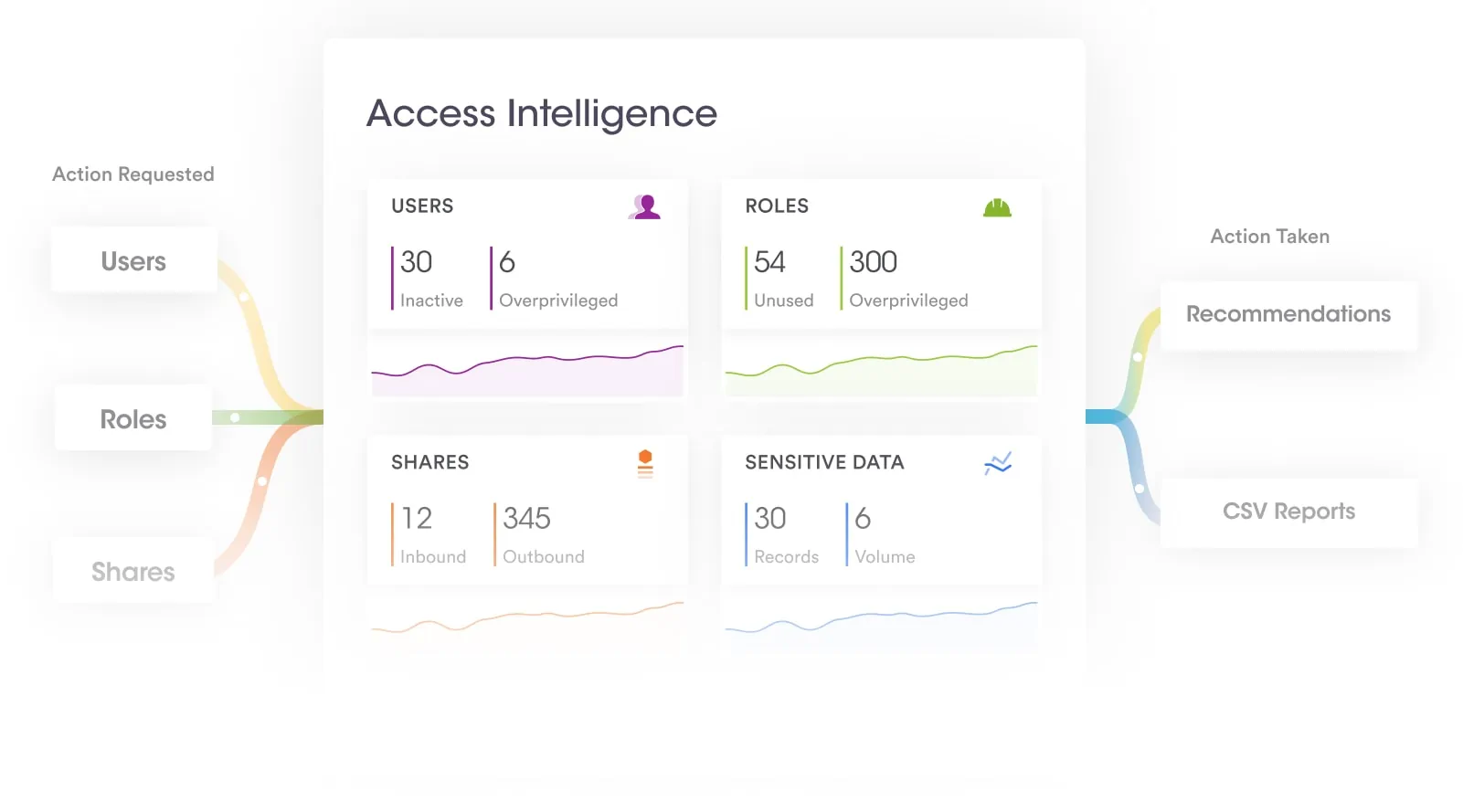
Access Intelligence dashboard displaying inactive and overprivileged users, unused and overprivileged roles, inbound and outbound shares, and sensitive data metrics

‍

Securiti AI approaches AI governance from the data layer. Veeam completed its $1.725 billion acquisition of Securiti in December 2025, combining data security posture management, privacy, and AI governance with Veeam's backup and recovery platform.

Key capabilities:

  • Sensitive data discovery and classification across structured and unstructured sources
  • Data access governance tied to AI pipelines
  • Recovery of data, pipelines, and model artifacts through Veeam

Where it falls short: Model and agent lifecycle governance is lighter than the governance specialists, and the roadmap is now shaped by the Veeam integration.

Securiti AI Pricing: Not published.

‍

10. Microsoft Agent 365

Best for: Enterprises standardized on Microsoft 365 and Copilot Studio.
‍

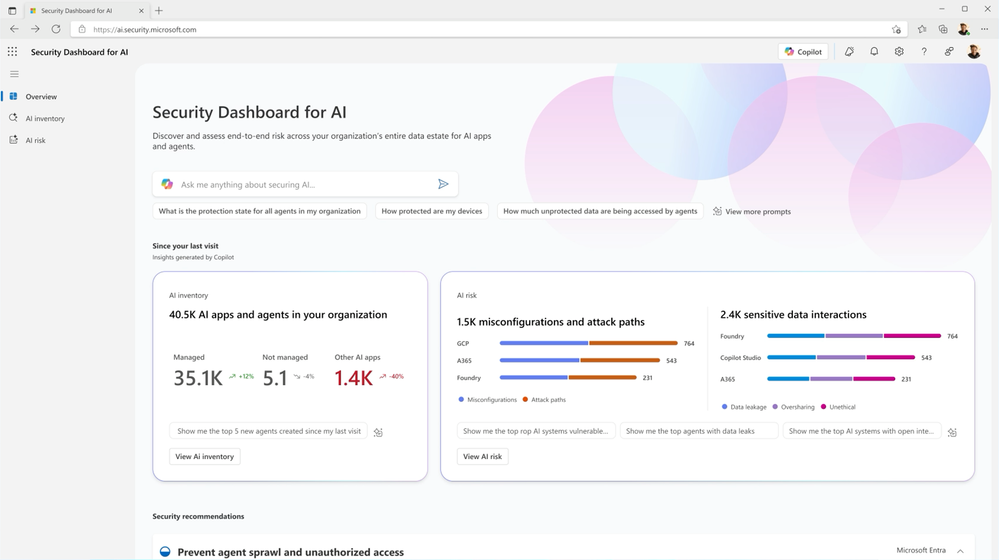
Microsoft Security Dashboard for AI showing enterprise AI inventory, managed and unmanaged AI applications, agent security risks, sensitive data interactions, and security recommendations.

‍

Microsoft Agent 365 became generally available on May 1, 2026, as a control plane for AI agents. It works through Entra, Defender, Purview, and Intune, and registry sync with Amazon Bedrock and Google Cloud is in public preview.

Key capabilities:

  • Agent registry with owners, publishers, and deployment status
  • Lifecycle rules, such as expiring inactive agents
  • Shadow AI page in the Microsoft 365 admin center

Where it falls short: Governance outside the Microsoft estate relies on synced, indirect controls, and it does not track AI spend across non-Microsoft vendors.

Microsoft Agent 365 Pricing: Included in Microsoft 365 E7, and sold as a standalone add-on for existing Microsoft 365 customers.

‍

How to Choose the Right AI Governance Platform for Your Team

Start with one question: what are you trying to govern?

👉  If employees and agents use AI you cannot see, prioritize multi-signal discovery, browser-level enforcement, and NHI governance: CloudEagle.ai, Singulr AI, and Microsoft Agent 365, with CloudEagle.ai giving IT teams one governance layer for AI tools, SaaS apps, and identities.

👉  If you build your own models and agents, prioritize lifecycle documentation, drift monitoring, and runtime agent constraints: IBM watsonx.governance, Credo AI, Holistic AI and Airia.

 👉  If privacy or legal owns AI governance, start with OneTrust or Securiti AI. If ServiceNow runs your risk processes, AI Control Tower keeps governance beside them.

👉  If your AI estate lives inside one cloud, the model governance built into Google's Vertex AI, AWS SageMaker, or DataRobot may cover model lifecycle needs. They do not discover shadow AI or govern employee AI use.

Before you sign, test four things in the demo:

  1. Pick one real AI tool or agent and trace it. Ask the vendor to show who owns it, what it can access, what it costs, and who approved it.
  2. Ask what happens at the moment of a violation. Reporting after the fact and blocking or redirecting in real time are very different products.
  3. Check what sits outside the platform's home ecosystem.
  4. Confirm the regulatory timeline the vendor is using. Under the EU's Digital Omnibus on AI, high-risk obligations now apply from 2 December 2027 for standalone systems and 2 August 2028 for AI embedded in regulated products (EU AI Act, as amended).
Setting up the program while choosing a tool? Our 30-day AI governance framework walks through the rollout step by step.

‍

What AI Governance Platforms Cost

Most AI governance vendors do not publish pricing. Microsoft is the main exception, bundling Agent 365 into Microsoft 365 E7 and selling it as an add-on. Everyone else quotes, and quotes usually follow one of four models:

  • Per AI system or model governed, which suits small, stable portfolios but climbs as agents multiply
  • Per user or seat, usually for governance staff rather than every employee
  • Platform license, a flat enterprise fee, often tiered by company size or modules
  • Consumption-based, measured on prompts logged, events processed or resources used

Budget too for integration, policy setup, and the internal time to run reviews. The count of AI tools and agents in scope moves a quote most, so run discovery first and ask every vendor how pricing changes when that count doubles.

‍

Conclusion

AI governance platforms have moved from documentation tools to control layers that discover, enforce, and prove. 

The right choice depends on what you govern: the AI your employees and agents use, the models your teams build, or the data feeding both.

For IT and Security teams that need to see every AI tool, control AI spend, and govern the agents and machine identities behind them, CloudEagle.ai brings it into one command center.

‍Book a demo to see your AI inventory in days.

‍

FAQs

1. Are there free AI governance platforms?

Not at enterprise scale. The NIST AI RMF is free, and open-source libraries can test models for bias, but neither discovers shadow AI, enforces policy, or keeps audit evidence.

2. Which platforms manage identity governance for AI agents?

CloudEagle.ai governs agents through the machine identities they run under, with owners, expiry dates, access reviews, and a kill switch. Microsoft Agent 365 covers Microsoft and synced agents, and OneTrust and Airia enforce agent permissions at runtime.

3. What is the best AI governance vendor for detecting shadow AI across enterprise apps?

Look for discovery that correlates several signals, since any single source misses tools. CloudEagle.ai combines SSO, browser, finance, and security-tool signals, including embedded AI in SaaS apps. Singulr AI and Holistic AI also detect shadow AI automatically.

4. What are the best AI governance platforms for enterprise compliance teams?

Credo AI, Holistic AI, IBM watsonx. Governance and OneTrust offer the deepest mapping to the EU AI Act, NIST AI RMF, and ISO 42001. CloudEagle.ai adds the usage, access, and enforcement logs auditors ask for across AI tools and SaaS.

6. Do we need an AI governance platform if we already have a CASB or GRC tool?

Usually yes. CASB tools block traffic, and GRC platforms track risk, but neither keeps an AI inventory, governs agent identities, or ties AI usage to spend. An AI governance platform connects to both and adds lifecycle control over the AI itself.

‍

Advertisement for a SaaS Subscription Tracking Template with a call-to-action button to download and a partial graphic of a tablet showing charts.Banner promoting a SaaS Agreement Checklist to streamline SaaS management and avoid budget waste with a call-to-action button labeled Download checklist.Blue banner with text 'The Ultimate Employee Offboarding Checklist!' and a black button labeled 'Download checklist' alongside partial views of checklist documents from cloudeagle.ai.Digital ad for download checklist titled 'The Ultimate Checklist for IT Leaders to Optimize SaaS Operations' by cloudeagle.ai, showing checklist pages.Slack Buyer's Guide offer with text 'Unlock insider insights to get the best deal on Slack!' and a button labeled 'Get Your Copy', accompanied by a preview of the guide featuring Slack's logo.Monday Pricing Guide by cloudeagle.ai offering exclusive pricing secrets to maximize investment with a call-to-action button labeled Get Your Copy and an image of the guide's cover.Blue banner for Canva Pricing Guide by cloudeagle.ai offering a guide to Canva costs, features, and alternatives with a call-to-action button saying Get Your Copy.Blue banner with white text reading 'Little-Known Negotiation Hacks to Get the Best Deal on Slack' and a white button labeled 'Get Your Copy'.Blue banner with text 'Little-Known Negotiation Hacks to Get the Best Deal on Monday.com' and a white button labeled 'Get Your Copy'.Blue banner with text 'Little-Known Negotiation Hacks to Get the Best Deal on Canva' and a white button labeled 'Get Your Copy'.Banner with text 'Slack Buyer's Guide' and a 'Download Now' button next to images of a guide titled 'Slack Buyer’s Guide: Features, Pricing & Best Practices'.Digital cover of Monday Pricing Guide with a button labeled Get Your Copy on a blue background.Canva Pricing Guide cover with a button labeled Get Your Copy on a blue gradient background.

Enter your email to
unlock the report

Oops! Something went wrong while submitting the form.
License Count
Benchmark
Per User/Per Year

Enter your email to
unlock the report

Oops! Something went wrong while submitting the form.
License Count
Benchmark
Per User/Per Year

Enter your email to
unlock the report

Oops! Something went wrong while submitting the form.
Notion Plus
License Count
Benchmark
Per User/Per Year
100-500
$67.20 - $78.72
500-1000
$59.52 - $72.00
1000+
$51.84 - $57.60
Canva Pro
License Count
Benchmark
Per User/Per Year
100-500
$74.33-$88.71
500-1000
$64.74-$80.32
1000+
$55.14-$62.34

Enter your email to
unlock the report

Oops! Something went wrong while submitting the form.

Enter your email to
unlock the report

Oops! Something went wrong while submitting the form.
Zoom Business
License Count
Benchmark
Per User/Per Year
100-500
$216.00 - $264.00
500-1000
$180.00 - $216.00
1000+
$156.00 - $180.00

Enter your email to
unlock the report

Oops! Something went wrong while submitting the form.

Get the Right Security Platform To Secure Your Cloud Infrastructure

Please enter a business email
Thank you!
The 2023 SaaS report has been sent to your email. Check your promotional or spam folder.
Oops! Something went wrong while submitting the form.

Access full report

Please enter a business email
Thank you!
The 2023 SaaS report has been sent to your email. Check your promotional or spam folder.
Oops! Something went wrong while submitting the form.

TL;DR

  • AI governance platforms discover every AI tool, model and agent in use, map them to policy and regulation, enforce guardrails, and keep audit evidence.
  • Gartner published its first Magic Quadrant for AI Governance Platforms in June 2026, naming IBM, ServiceNow and Truyo as Leaders.
  • The category splits in two: platforms that govern how employees and agents use AI, and platforms that govern the models your teams build.
  • CloudEagle.ai leads for IT and Security teams that need shadow AI discovery, AI spend control and non-human identity governance in one place.
  • Few vendors publish pricing, so ask how the quote scales as your count of AI tools and agents grows.

‍

‍

Only 13% of organizations believe they have the right governance in place for AI agents, according to Gartner. Gartner also expects the average Fortune 500 enterprise to run more than 150,000 agents by 2028, up from fewer than 15 in 2025.

Inside most companies, that gap already looks familiar. Your security team blocks one AI tool, and by Friday three more show up in expense reports. An agent built by a contractor who left last month still has write access to your CRM.

An AI governance platform closes it, and the payoff is measurable. In a Gartner survey of 360 organizations, those that deployed AI governance platforms were 3.4 times more likely to achieve high effectiveness in AI governance.

‍

An AI governance platform is software that discovers the AI tools, models, and agents an organization uses, assesses their risk against policy and regulations such as the EU AI Act, enforces controls on access and data, and records audit-ready evidence.
👉 The leading platforms in 2026 include CloudEagle.ai, IBM watsonx.governance, ServiceNow AI Control Tower, Credo AI, and OneTrust.

‍

Below, we compare the 10 best AI governance platforms for enterprise IT and Security teams and show how to pick the right one for what you need to govern.

‍

What an AI Governance Platform Does: 4 Core Capabilities

Every AI governance platform does some version of four jobs.

Gartner describes the category as a central registry of AI systems that automates approvals for new AI use cases and agents and runs guardrails in real time (Gartner Peer Insights).

1. AI discovery and inventory: The platform finds every AI tool, model, copilot and agent in use, including shadow AI that employees adopted without IT.

Ask vendors which signals they read: SSO, browser, finance records, cloud platforms, or all of them.

2. Risk and compliance mapping: Each AI system gets a risk classification mapped to frameworks such as the EU AI Act, NIST AI RMF, and ISO 42001.

The better platforms generate evidence as a byproduct of normal work.

3. Policy enforcement and guardrails: Written policy turns into controls: who can use which AI tools, what data can be shared with them, and what actions an agent may take.

Some platforms only report violations; others block, redirect, or require approval at the moment of use.

4. Observability and audit trails: The platform tracks usage, token consumption, agent actions, and model behavior over time, and logs every decision and exception for auditors.

Some AI governance platforms govern how employees and agents use AI across the business: shadow AI, embedded SaaS AI, AI spend, and the machine identities agents run under. 

‍

Others govern the models your data science teams build: lifecycle documentation, bias testing, and drift monitoring. Buying the wrong half is the costliest mistake in this market, so the table below shows what each platform governs. 

‍

Where Does Your AI Governance Rank?

69% have no accountable AI owner. Benchmark yours before you pick a platform
Grab your copy

‍

How We Evaluated These AI Governance Platforms

We assessed each platform against six criteria using vendor documentation, 2026 announcements, analyst research, and peer reviews. 

Criterion What we looked at
Coverage Whether it governs employee AI usage, embedded SaaS AI, models, agents, or a combination
Discovery depth How many signals feed the AI inventory and whether shadow AI is found automatically
Enforcement Whether the platform only reports, or also blocks, redirects and routes approvals
Agent and NHI governance Owners, permissions, lifecycle and shutdown controls for AI agents and machine identities
Compliance evidence Mapping to the EU AI Act, NIST AI RMF and ISO 42001, plus audit-ready logs
Validation and time to value Analyst recognition, peer reviews and how quickly teams get usable visibility

‍

10 Best AI Governance Platforms in 2026 - For IT & Security Teams

The table below maps all ten platforms across capability dimensions critical to enterprise AI governance decisions.

Platform Best for What it governs Gartner MQ 2026 Shadow AI discovery Agent and NHI governance
CloudEagle.ai IT, Security and Procurement teams Employee AI usage, AI spend, agents, NHIs, SaaS Not in MQ (KuppingerCole 2026 Leadership Compass) Automated, multi-signal Owners, expiry, access reviews, kill switch
IBM watsonx.governance Regulated enterprises with model risk programs Models, agents, AI use cases Leader Via Guardium AI Security Lifecycle monitoring; containment in preview
ServiceNow AI Control Tower Organizations already on ServiceNow AI assets, models, agents Leader Via Service Graph connectors Lifecycle workflows, kill switch protocol
Credo AI Policy-led risk and compliance teams AI use cases, models, agents Visionary Intake and registry based Agent registry; Agent Governor in preview
OneTrust AI Governance Privacy and legal-led programs Models, agents, datasets, vendors Visionary Cloud AI discovery Agent registration, MCP policy controls
Holistic AI Multi-jurisdiction compliance Models, agents, applications Challenger Automated Guardian Agents
Airia Teams building and orchestrating agents Agents, models, MCP tools Visionary Automated Runtime agent constraints
Singulr AI Security teams securing GenAI use SaaS AI, embedded AI, agents Not in MQ Automated Agent Pulse
Securiti AI (Veeam) Data and privacy-first programs Data feeding AI systems Not in MQ Partial Partial
Microsoft Agent 365 Microsoft-standardized enterprises Microsoft and synced agents Not in MQ Shadow AI page in admin center Agent registry and lifecycle actions

‍

1. CloudEagle.ai

Best for: IT Teams, CIOs, CISOs, and Chief AI Officers who need to govern employee AI usage, AI spend, and AI agents alongside the rest of the SaaS stack.

‍

‍

CloudEagle.ai is an AI Governance, SaaS Security, and SaaS management platform that gives enterprises one command center to discover, secure, govern, and optimize their SaaS and AI stack, including AI usage control and both human and non-human identities. 

KuppingerCole Analysts named it a Product Leader in the 2026 Leadership Compass for SaaS Security and AI Governance, and Gartner named it a Representative Vendor in the 2026 Market Guide for Identity Governance and Administration.

It starts from what IT and Security teams actually face: AI tools employees adopt on their own, AI spend spread across vendor consoles, and agents running under machine identities nobody owns.

‍

Customers have saved $3B+ across SaaS and AI spend, with 30-minute onboarding and 500+ direct integrations.

‍

a. Find every AI tool employees use, approved or not

AI tools enter the stack through free trials, card purchases, and personal accounts that never touch SSO. 

CloudEagle.ai's shadow AI discovery builds a live inventory from EagleIQ, its proprietary AI application inventory, and correlates browser, SSO, finance, Zscaler, and CrowdStrike signals to surface sanctioned and unsanctioned tools in one dashboard. That is how teams catch AI tools running silently before they become embedded in daily work.

Once every tool is visible, the next question is what each one costs and who is using it.

b. See what every AI tool consumes and costs, down to the user and API key

AI tools bill in licenses, tokens, and credits, each inside its own vendor console. AI usage control brings that consumption into one view, tracks fixed licenses and pay-as-you-go tokens side by side, and maps cost to users, teams, cost centers, API keys, and non-human identities. 

‍

ChatGPT usage report showing a user-wise line chart tracking API usage across eight users over a 30-day period.

‍

Finance teams get AI spend they can track by model, user, and department with per-user or team budgets and alerts, and IT reclaims licenses inactive for 90 or 180 days through Slack or Teams approval workflows.

Domo ran Claude, Cursor, and Gemini across engineering, product, and go-to-market teams, with $2.4M in annual AI spend split across separate vendor consoles. 

Once CloudEagle.ai pulled that consumption into one view, Domo found 34% of its AI licenses had no activity in 90 days. Removing inactive access and consolidating overlapping subscriptions saved $1.2M in the first quarter, and AI spend reconciliation moved from quarterly to weekly.

With usage mapped, the next step is enforcing policy where AI is actually used.

c. Stop sensitive data from reaching unapproved AI, right in the browser

Most AI use happens in a browser tab. CloudEagle.ai's browser plugin brings AI policy enforcement to that layer. When someone opens an unapproved AI tool, a flash page redirects them to an approved one. 

‍

CloudEagle.ai Flash Page displaying a blocked ChatGPT website with options to browse anyway or dismiss the access request.

‍

Policies set by user, role, department, and data type monitor or block PII, credentials, financial data, and PHI before they are entered, and every warning, block, and override is logged for audit.

The last gap is the AI that acts on its own.

d. Give every AI agent and API key an owner, an expiry date, and a kill switch

Service accounts, API keys, and AI agents are often created with no owner and no expiry. Non-human identity management discovers AI agents, MCP servers, service accounts, and API keys, assigns an owner and expiry to each, and pulls them into access reviews and least-privilege checks. 

‍

CloudEagle.ai Kill Switch dashboard showing Azure managed identity details, assigned roles, credential type, activity logs, and options to rotate secrets or revoke access.

‍

AI agent management shows what each agent can reach, flags agents whose owner has left, and gives admins a kill switch for any agent that should not be running.

‍

"Once AI adoption accelerated across teams, visibility alone wasn't enough. We needed clear rules around who could use AI tools, under what conditions, and how those decisions were enforced and reviewed. CloudEagle helped us move from ad-hoc approvals to structured, defensible AI governance." Aditya Khosla, CTO, Iterative Health 

‍

Where it falls short: CloudEagle.ai governs how AI is used across the business. Teams that need model-level bias testing or drift monitoring for models they build in-house will pair it with a model governance tool.

CloudEagle.ai Pricing: Modular, with custom quotes based on the modules you need. Contact sales.

‍

‍

2. IBM watsonx.governance

Best for: Banks, insurers and other regulated enterprises with formal model risk programs.

‍

IBM watsonx dashboard displaying AI model compliance status, model inventory, departmental distribution, lifecycle stages, validation metrics, and deployment statistics.

‍

IBM watsonx.governance manages risk and compliance across the lifecycle of models, applications and agents, and Gartner placed IBM highest among the 2026 Leaders. In October 2026, IBM added agent discovery and containment, including a kill switch, across Amazon Bedrock, Microsoft Foundry and Google Gemini as a tech preview.

Key capabilities:

  • Lifecycle governance from use-case intake to retirement
  • Risk Atlas covering agentic AI risks, plus bias and drift monitoring
  • Use-case discovery through Guardium AI Security

Where it falls short: Heavy to deploy outside the IBM ecosystem, and focused on systems teams build rather than the AI tools employees adopt on their own.

IBM watsonx.governance Pricing: An Essentials SaaS tier is billed per resource unit; enterprise pricing is quoted. Teams comparing options can review our IBM watsonx.governance alternatives.

‍

3. ServiceNow AI Control Tower

Best for: Enterprises that already run risk, change and service management on ServiceNow.

‍

ServiceNow AI Control Tower dashboard displaying enterprise AI productivity, usage trends, AI agents, models, datasets, and task execution metrics.

‍

ServiceNow AI Control Tower is a governance layer above native and third-party AI, and a 2026 Gartner Leader. The June 2026 release added discovery connectors for Databricks, Snowflake and Hugging Face, publishing to Microsoft Agent 365, and pre-built compliance content.

Key capabilities:

  • Vendor-agnostic inventory of AI agents, models and workflows
  • Approval workflows tied to each asset's lifecycle phase
  • Kill switch protocol to deactivate and reinstate agents

Where it falls short: Value depends on being a ServiceNow shop, and configuration takes real effort for teams early in their governance program.

ServiceNow Pricing: Not published; sold within ServiceNow enterprise agreements.

‍

4. Credo AI

Best for: Risk and compliance teams that need regulatory mapping across a multi-cloud AI portfolio.

‍

Credo AI governance dashboard showing AI use cases, agents, applications, risk classifications, governance progress, model inventory, and compliance status.

‍

Credo AI is a policy-first platform that turns regulation and internal policy into requirements teams can act on, and a Gartner Visionary. Its governance agent, GAIA, became generally available in May 2026 to automate intake and assessments, and Agent Governor followed in July 2026.

Key capabilities:

  • Policy packs aligned to the EU AI Act, NIST AI RMF and ISO 42001
  • Central registry of AI use cases, models and agents
  • Audit-ready reporting for regulators and boards

Where it falls short: Stronger on assessment and documentation than on runtime enforcement, and it assumes a written AI policy already exists.

Credo AI Pricing: Custom. See how it compares in our Credo AI alternatives guide.

‍

5. OneTrust AI Governance

Best for: Privacy, legal and compliance-led organizations already using OneTrust.

‍

OneTrust dashboard displaying AI project risk distribution, workflow progress, project status, and recent governance activity.

‍

OneTrust extends its privacy and GRC platform to AI, and is a Gartner Visionary. In 2026, it added agent detection across Bedrock, Azure Foundry, Vertex and Databricks, then launched CORIE in September to enforce policy on agent actions at runtime.

Key capabilities:

  • AI inventory spanning models, agents, datasets and vendors
  • Agent registration with enforced permissions and MCP policy controls
  • Runtime guardrails that block, redact or restrict AI behavior

Where it falls short: The AI modules are newer than the privacy core, and full value usually means adopting more of the OneTrust platform.

OneTrust Pricing: Custom enterprise pricing. To know how CloudEagle.ai compares with OneTrust, check out our guide on OneTrust Alternatives. 

‍

6. Holistic AI

Best for: Organizations tracking AI regulation across several jurisdictions.

‍

Holistic AI dashboard showing shadow AI discovery, technology inventory, risk distribution, platform growth, task executions, and security activity analytics.

‍

Holistic AI covers discovery, risk assessment and enforcement in production, and was Gartner's sole 2026 Challenger. Holistic AI says it scored highest for AI Discovery and Registry in Gartner's Critical Capabilities research.

Key capabilities:

  • Live inventory of models, agents, apps and third-party AI, including shadow AI
  • Guardian Agents that monitor and intervene when a policy threshold is breached
  • Evidence mapped to the EU AI Act, NIST AI RMF and ISO 42001

Where it falls short: Peer-review volume is still thin, and it does not cover AI spend or SaaS access governance.

Holistic AI Pricing: Custom.

‍

7. Airia

Best for: Teams building and running many internal agents that want governance where the agents execute.

Dark-themed AI analytics dashboard displaying model costs over time, account balance, total requests, average latency, error rate, and cost distribution across Claude, ChatGPT, Gemini, and Copilot.

‍

Airia combines AI orchestration, security and governance in one control layer. It launched its AI Governance product in January 2026 and is a Gartner Visionary.

Key capabilities:

  • Discovery of AI tools, agents and MCP servers across identity, network, SaaS and browser signals
  • Agent constraints enforced at the function-call level, including for agents built elsewhere
  • Execution-level logging for audit

Where it falls short: Strongest when you also orchestrate agents in Airia, and as a younger vendor, reference checks take longer.

Airia Pricing: Not published. Compare options in our Airia alternatives guide.

‍

8. Singulr AI

Best for: Security teams focused on securing employee GenAI use and agent activity.

‍

Singulr AI dashboard displaying AI governance trends, unvetted and unapproved AI services, risk classifications, AI service categories, and infrastructure insights.

‍

Singulr AI positions itself as an AI and agentic control plane. Its Agent Pulse product discovers agents across Copilot Studio, Agentforce, AWS, Google Cloud, and local machines, and in July 2026 coverage extended to endpoints, AI gateways, and MCP.

Key capabilities:

  • Discovery of public AI services, embedded SaaS AI, and agents
  • Singulr Pulse risk intelligence and AI red teaming
  • Runtime protection against prompt injection and data leakage

Where it falls short: Not evaluated in the Gartner Magic Quadrant, and it does not cover AI license spend or identity lifecycle across SaaS. See our Singulr alternatives.

Singulr AI Pricing: Contract-based; also available through AWS Marketplace.

‍

9. Securiti AI (now part of Veeam)

Best for: Privacy-sensitive enterprises whose first AI risk is sensitive data reaching models.

‍

Access Intelligence dashboard displaying inactive and overprivileged users, unused and overprivileged roles, inbound and outbound shares, and sensitive data metrics

‍

Securiti AI approaches AI governance from the data layer. Veeam completed its $1.725 billion acquisition of Securiti in December 2025, combining data security posture management, privacy, and AI governance with Veeam's backup and recovery platform.

Key capabilities:

  • Sensitive data discovery and classification across structured and unstructured sources
  • Data access governance tied to AI pipelines
  • Recovery of data, pipelines, and model artifacts through Veeam

Where it falls short: Model and agent lifecycle governance is lighter than the governance specialists, and the roadmap is now shaped by the Veeam integration.

Securiti AI Pricing: Not published.

‍

10. Microsoft Agent 365

Best for: Enterprises standardized on Microsoft 365 and Copilot Studio.

‍

Microsoft Security Dashboard for AI showing enterprise AI inventory, managed and unmanaged AI applications, agent security risks, sensitive data interactions, and security recommendations.

‍

Microsoft Agent 365 became generally available on May 1, 2026, as a control plane for AI agents. It works through Entra, Defender, Purview, and Intune, and registry sync with Amazon Bedrock and Google Cloud is in public preview.

Key capabilities:

  • Agent registry with owners, publishers, and deployment status
  • Lifecycle rules, such as expiring inactive agents
  • Shadow AI page in the Microsoft 365 admin center

Where it falls short: Governance outside the Microsoft estate relies on synced, indirect controls, and it does not track AI spend across non-Microsoft vendors.

Microsoft Agent 365 Pricing: Included in Microsoft 365 E7, and sold as a standalone add-on for existing Microsoft 365 customers.

‍

How to Choose the Right AI Governance Platform for Your Team

Start with one question: what are you trying to govern?

👉  If employees and agents use AI you cannot see, prioritize multi-signal discovery, browser-level enforcement, and NHI governance: CloudEagle.ai, Singulr AI, and Microsoft Agent 365, with CloudEagle.ai giving IT teams one governance layer for AI tools, SaaS apps, and identities.

👉  If you build your own models and agents, prioritize lifecycle documentation, drift monitoring, and runtime agent constraints: IBM watsonx.governance, Credo AI, Holistic AI and Airia.

 👉  If privacy or legal owns AI governance, start with OneTrust or Securiti AI. If ServiceNow runs your risk processes, AI Control Tower keeps governance beside them.

👉  If your AI estate lives inside one cloud, the model governance built into Google's Vertex AI, AWS SageMaker, or DataRobot may cover model lifecycle needs. They do not discover shadow AI or govern employee AI use.

Before you sign, test four things in the demo:

  1. Pick one real AI tool or agent and trace it. Ask the vendor to show who owns it, what it can access, what it costs, and who approved it.
  2. Ask what happens at the moment of a violation. Reporting after the fact and blocking or redirecting in real time are very different products.
  3. Check what sits outside the platform's home ecosystem.
  4. Confirm the regulatory timeline the vendor is using. Under the EU's Digital Omnibus on AI, high-risk obligations now apply from 2 December 2027 for standalone systems and 2 August 2028 for AI embedded in regulated products (EU AI Act, as amended).
Setting up the program while choosing a tool? Our 30-day AI governance framework walks through the rollout step by step.

‍

What AI Governance Platforms Cost

Most AI governance vendors do not publish pricing. Microsoft is the main exception, bundling Agent 365 into Microsoft 365 E7 and selling it as an add-on. Everyone else quotes, and quotes usually follow one of four models:

  • Per AI system or model governed, which suits small, stable portfolios but climbs as agents multiply
  • Per user or seat, usually for governance staff rather than every employee
  • Platform license, a flat enterprise fee, often tiered by company size or modules
  • Consumption-based, measured on prompts logged, events processed or resources used

Budget too for integration, policy setup, and the internal time to run reviews. The count of AI tools and agents in scope moves a quote most, so run discovery first and ask every vendor how pricing changes when that count doubles.

‍

Conclusion

AI governance platforms have moved from documentation tools to control layers that discover, enforce, and prove. 

The right choice depends on what you govern: the AI your employees and agents use, the models your teams build, or the data feeding both.

For IT and Security teams that need to see every AI tool, control AI spend, and govern the agents and machine identities behind them, CloudEagle.ai brings it into one command center.

‍Book a demo to see your AI inventory in days.

‍

FAQs

1. Are there free AI governance platforms?

Not at enterprise scale. The NIST AI RMF is free, and open-source libraries can test models for bias, but neither discovers shadow AI, enforces policy, or keeps audit evidence.

2. Which platforms manage identity governance for AI agents?

CloudEagle.ai governs agents through the machine identities they run under, with owners, expiry dates, access reviews, and a kill switch. Microsoft Agent 365 covers Microsoft and synced agents, and OneTrust and Airia enforce agent permissions at runtime.

3. What is the best AI governance vendor for detecting shadow AI across enterprise apps?

Look for discovery that correlates several signals, since any single source misses tools. CloudEagle.ai combines SSO, browser, finance, and security-tool signals, including embedded AI in SaaS apps. Singulr AI and Holistic AI also detect shadow AI automatically.

4. What are the best AI governance platforms for enterprise compliance teams?

Credo AI, Holistic AI, IBM watsonx. Governance and OneTrust offer the deepest mapping to the EU AI Act, NIST AI RMF, and ISO 42001. CloudEagle.ai adds the usage, access, and enforcement logs auditors ask for across AI tools and SaaS.

6. Do we need an AI governance platform if we already have a CASB or GRC tool?

Usually yes. CASB tools block traffic, and GRC platforms track risk, but neither keeps an AI inventory, governs agent identities, or ties AI usage to spend. An AI governance platform connects to both and adds lifecycle control over the AI itself.

‍

CloudEagle.ai recognized in the 2025 Gartner® Magic Quadrant™ for SaaS Management Platforms
Download now
gartner chart
5x
Faster employee
onboarding
80%
Reduction in time for
user access reviews
30k
Workflows
automated
$15Bn
Analyzed in
contract spend
$2Bn
Saved in
SaaS spend

Streamline SaaS governance and save 10-30%

Book a Demo with Expert
CTA image